
UK MMFs in Focus: Practical Implications of the TMPR Extension
- Published
- in Industry Updates
In this Article
This Article explores the reform of the UK Money Market Fund Regulation (“MMFR”) and what it means for money market funds (“MMFs”) and managers. The overall shape of the regime is now relatively clear from the published legislation. It implies:
- An equivalence-based system with conditionality powers;
- Broader policy criteria than the OFR; and
- FCA registration requirements.
The key uncertainty lies in the timing and substance of any conditions that may be imposed on incoming overseas MMFs.
Introduction
There were two announcements in the UK in May impacting MMFs:
- On 14 May 2026, HM Treasury (“HMT”) and the Financial Conduct Authority (“FCA”) announced plans to reform the UK MMFR regime.
- Alongside the reform announcement, HMT has confirmed its intention to extend the Temporary Marketing Permissions Regime (“TMPR”), which is of particular significance for EU-domiciled MMFs marketed in the UK.
We have summarised below the key points arising from the announcements and their implications for asset managers and funds operating in, and in particular marketing to, the UK market.
The Fifth Joint EU-UK Financial Regulatory Forum
To fully appreciate the significance of the MMFs reform, the UK effort described in this article must be situated within the broader context of EU-UK discussions on deeper regulatory convergence.
Prior to the above announcements, the fifth meeting of the Joint EU-UK Financial Regulatory Forum took place in London on 11 March 2026.
In their joint statement, under the markets reform discussion, the UK and the EU “exchanged observations on practices that enhance the resilience of their respective MMFs sectors, and look forward to constructive engagement going forward”. Both sides also “agreed on the importance of implementing global standards to ensure the resilience of the funds sector, and on continued coordinated engagement in international fora, such as the Financial Stability Board (“FSB”), to enhance collective understanding of structural vulnerabilities within the non-bank financial intermediation (“NBFI”) ecosystem”.
Impact on MMFs in or Coming to the UK
UK-Domiciled MMFs (Higher Liquidity)
The reforms will establish a new regulatory framework under which most requirements for UK-domiciled MMFs will be set out in FCA rules and guidance, rather than in retained EU legislation.
A central feature of the new framework is the expectation that UK MMFs hold higher levels of liquidity. This is expected to involve a significant increase in the minimum liquid asset requirement for all MMFs, raising daily liquid assets (“DLA”) and weekly liquid assets (“WLA”) to 15% and 50% of assets respectively, together with the “delinking” of liquidity levels from the imposition of tools such as liquidity fees or redemption gates for stable NAV MMFs. These reforms are aligned with EU guidance issued on 11 May 2026 recommending 40% liquidity for stable-NAV MMFs, demonstrating a degree of cross-border regulatory convergence. The FCA has indicated that it will issue a statement shortly with further details on its plans.
EU-Domiciled MMFs (Extended TMPR & Overseas MMFs Regime)
The TMPR extension announcement is of considerable significance for EU-domiciled MMFs marketing to the UK, which represent approximately 90% of total assets under management in sterling-denominated MMFs. At present, EU-domiciled MMFs that notified the FCA prior to the Brexit deadline continue to market into the UK under the TMPR.
Critically, the equivalence determination made by HMT in respect of EU UCITS under the Overseas Funds Regime (“OFR”) explicitly excludes UCITS that are MMFs. HMT has stated that it will consider the equivalence of the EU MMF Regulation for OFR purposes once reforms to the UK MMF regime have been finalised. As a result, EU-domiciled MMFs currently do not have a permanent route to UK market access equivalent to that available to non-MMF UCITS under the OFR.
To address this, HMT has confirmed its intention to extend the TMPR, with a view to establishing a longer-term solution on market access in line with the UK’s framework and process for recognition of overseas firms and funds. This extension provides welcome certainty that EU-domiciled MMFs registered under the TMPR can continue to be promoted to UK investors whilst the permanent access arrangements are developed.
MMF Reform Timeline
The key milestones and expected timeline are as follows:
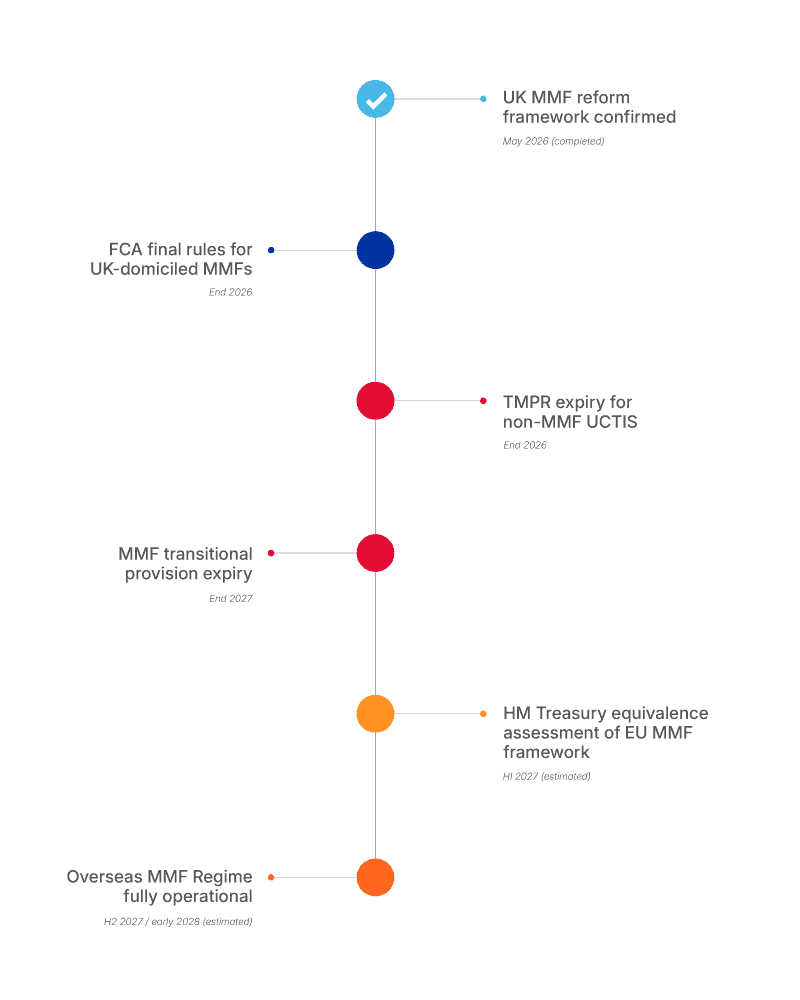
| Milestone | Estimated Date | What to expect |
| UK MMF reform framework confirmed | May 2026 (completed) | The FCA has indicated that it will issue a statement shortly with further details on its plans, including the specific rules and guidance that will apply to UK MMFs under the reformed framework. |
| FCA final rules for UK-domiciled MMFs | End 2026 | |
| TMPR expiry for non-MMF UCITS | End 2026 | As regards the TMPR, the regime was most recently extended to the end of 2026 for all funds, including MMFs. The non-MMF TMPR transition to the OFR is expected to be completed by September 2026 (when the final landing slot closes), with the TMPR ceasing for those funds by December 2026. |
| MMF transitional provision expiry, if required | End 2027 | For MMFs, however, HMT has indicated that it can and will extend the TMPR beyond 31 December 2026 if needed to avoid any cliff-edge risks for MMF products. The 14 May 2026 announcement confirming HMT’s intention to extend the TMPR for MMFs, with a view to establishing a longer-term solution, reinforces this position.
|
| HMT equivalence assessment of EU MMF framework | H1 2027 (estimated) | Thus far, the only dated milestone the Government has put in print is a Q4 2026 “expected” go‑live for the new regime (subject to Parliament). Everything in H1 2027 follows from implementation sequencing after that date.
The FCA has already trailed a distinct, later consultation on stress‑testing parameters once the reformed regime is in force, which naturally fits a 2027 window. The HMT policy note hard‑codes the “until end of 2027” bridge for certain EU MMFs and sets out that future access is via HMT determinations, hence 2027 and the period thereafter are the logical slots for determinations and any accompanying conditions. By 2028 the international bodies expect to assess the effectiveness of MMF and related market‑liquidity reforms, which typically prompts domestic supervisory reviews and, where needed, incremental tweaks. |
| Overseas MMF Regime fully operational | H2 2027 / early 2028 (estimated) |
What Do We Know About the Overseas MMF Regime Now?
Although not yet final legislation, the detailed HMT policy already provides a comprehensive picture of what the permanent access route for non-UK MMFs is expected to look like. The permanent access route for non-UK MMFs will operate through a bespoke Overseas MMF Regime that is distinct from, but modelled on, the OFR used for UCITS. The key features are set out in the near-final Statutory Instrument published by HMT in December 2023.
The Equivalence Determination Framework
Unlike the OFR equivalence test (which focuses purely on investor protection equivalence), the Overseas MMF Regime applies a broader three-limbed test. HMT may make a determination in respect of a jurisdiction if it is satisfied that three policy outcomes are met:
- Protecting the financial integrity or stability of the financial markets of the UK.
- Promoting effective market competition for consumers.
- Facilitating the competitiveness of the UK.
In deciding whether these outcomes are met, the legislation requires HMT to consider key elements of the regulatory approach used in the relevant overseas jurisdiction. This is a notably different and arguably more flexible framing than the OFR’s strict “equivalent investor protection” test under section 271B of FSMA.
Conditional Equivalence
The legislation provides HMT with an explicit power to impose conditions on incoming MMFs as part of its determination. This means that, for example, EU MMFs marketing into the UK could potentially be required to meet additional UK-specific liquidity or reporting requirements beyond those imposed by their home state regulator.
Registration Requirement
Once an equivalence determination is made, overseas MMFs will not automatically gain access to the UK market. They must register with the FCA under one of three routes:
- Section 271A FSMA (the OFR gateway, where applicable); or
- Section 272 FSMA (the individually recognised overseas scheme route); or
- The UK’s National Private Placement Regime (“NPPR”).
This provides a tiered system allowing different categories of overseas MMFs to access the UK market through the channel most appropriate to their investor base (retail versus professional).
Reporting and Supervision
The FCA will have powers to require reporting from approved overseas MMFs, in line with the requirements that apply to UK-authorised MMFs. This means overseas MMFs marketing into the UK should expect to be subject to FCA data collection and ongoing supervisory oversight.
Key Differences from the Standard OFR
| Feature | OFR (for UCITS) | Overseas MMF Regime |
| Requirements Level | Light touch | Heavier requirements |
| Equivalence test | Investor protection equivalence (s.271B FSMA) | Three-limbed test: financial stability, competition, competitiveness |
| Conditional recognition | Government determined no additional requirements for EU UCITS | Explicit power to impose conditions on incoming funds |
| Financial stability dimension | Not a direct criterion | Expressly included as one of the three policy outcomes |
| Registration routes | Section 271A (OFR) only | Section 271A, section 272, or NPPR |
| Regulatory oversight | FCA supervision and notification requirements | FCA reporting powers equivalent to UK-authorised MMFs |
What Remains Unknown
A few critical questions are still outstanding:
Will the EU MMF framework be found equivalent?
HMT will consider the equivalence of the EU MMF Regulation once reforms to the UK MMF regime have been finalised. This is a sequencing point — the UK wants first to settle its own domestic standards and then assess whether the EU framework achieves comparable outcomes. An equivalence assessment for the EU MMF framework is unlikely before mid-2027 at the earliest.
What conditions might be imposed?
The power to impose conditions on incoming MMFs raises the question of whether the UK will require EU-domiciled sterling MMFs to meet UK-specific liquidity buffers (e.g. the proposed 15% DLA / 50% WLA) or whether the EU’s own reformed requirements will be sufficient. Given that the UK reforms and the EU’s own reforms are broadly converging, there is a reasonable prospect that conditions may be limited, but this is not guaranteed.
Transitional Protection
To avoid cliff-edge risks, the Statutory Instrument includes a transitional provision allowing MMFs that are currently marketing under the TMPR to continue to be marketed in the UK until the end of 2027. This provides a longer runway than the end-2026 TMPR expiry for non-MMF UCITS and signals that HMT recognises the complexity of delivering a permanent regime for MMFs.
Irish & Luxembourg Domiciled MMFs
Irish and Luxembourg domiciled MMFs, which represent a significant portion of the sterling MMF market, are directly affected by these developments. As both Irish and Luxembourg domiciled MMFs operate under the EU MMF Regulation and currently access the UK market via the TMPR, managers should monitor the UK’s equivalence assessment process closely. The outcome will determine whether these MMFs can continue to be marketed to UK investors under the permanent Overseas MMF Regime, and on what terms.
Practical Implications for EU-Domiciled MMFs
For managers of EU-domiciled sterling MMFs (including Irish and Luxembourg domiciled funds), the above picture suggests:
- No immediate action required: Ensure TMPR registration remains in good standing. The transitional provision to end-2027 provides breathing room.
- Prepare for conditional equivalence: The permanent route is likely to involve conditions, around liquidity, reporting, or operational resilience, that go beyond current EU MMF Regulation requirements.
- Dual compliance risk: If the UK imposes conditions aligned to its reformed domestic MMF rules (15% DLA / 50% WLA), EU-domiciled MMFs may need to meet both EU and UK standards simultaneously.
- The NPPR as a fallback: For MMFs marketed to professional investors, the NPPR route may remain available regardless of whether an equivalence determination is made, although it does not permit marketing to retail investors.
- Timeline planning: A realistic planning assumption would be that the permanent overseas MMF regime will not be fully operational until H2 2027 or early 2028, given the sequencing of UK domestic reform finalization, the equivalence assessment process, and FCA implementation.
Important Notice
This Article is provided for general information purposes only and does not constitute legal, regulatory, or investment advice. The regulatory landscape concerning MMFs is evolving, and the final rules may differ from the positions described herein. Clients should seek independent professional advice tailored to their specific circumstances before taking any action in reliance upon this information.
How can Maples GRS help?
We can keep you updated on the evolution of this reform up until the entry into force of the new permanent MMF overseas regime and guide you, step-by-step, in your planning towards entering or remaining in the UK market, throughout and after the TMPR.
For further information, please liaise with your usual Maples Group Global Registration Services contact or the contributors.
To learn more about our Global Registration Services, please visit our dedicated webpage or get in touch with us.
